Search This Blog

Showing posts with label Wargames. Show all posts

Saturday, August 27, 2011

No Retreat!


I've been really excited about the new GMT deluxe edition treatment of the Victory Point Games game No Retreat!: The Russian Front.  What appeals to me about it is that it is an elegant, but not simplistic take on the entire East Front. It's very playable, and has really interesting "design for effect" aspects.


I was able to pick up my copy at WBC and after chomping at the bit to play it, I got the chance at SNEW, with Nick Avtges, who had played it a few times himself at WBC. He was a great teacher - even though I had read the rules a number of times, it's easy to forget minor things the first time you play a game, so it's good to have one played slightly more experienced. We ended up playing the first scenario with me as the Russians and he won via sudden death VPs - it turned out we misread the rules and he was actually short by one, but it gave me a sense of how combat worked. So, we switched sides and played again. The second time went the distance (5 turns out of the campaign games 22+ turns.) and I ended up one victory point short of victory. We then tried the second scenario which covers turns 7 through 10, and I once again lost a close one.

I taught Jerad No Retreat! yesterday afternoon. He played the Germans and I gave him a few hints on the first few turns to get him started and to help him make effective attacks. After that he did a great job on his own, and we had a great, tense game.

In No Retreat there are a number of ways to win and one of them is to control three out of five objective hexes. These hexes give an extra left column shift so are extra hard to take, and smart Russian play puts fortifiable units there, which ignore retreat results on the CRT once fortified. Unfortunately I was not able to get one of those units to Sevastopol, and he was able to send a Panzer division down there to clear it out in the Spring of 1942. In the last clear weather turn of 1942, Jerad swept a bunch of units into the Moscow area and managed to push me out in a way that led to no way to counterattack on my half of the turn. Since he had taken Leningrad in 1941, the German juggernaut got an Objective Victory on turn 9!


Apparently I'm not very good at No Retreat yet, but I'm finding it a ton of fun and highly recommend it!

Chris

Sunday, August 21, 2011

WBC Wrap-Up

The end of the WBC was fun and exciting, and I was only somewhat zombie-fied. I played in the Princes of Florence semi-final and the Brass semifinal, but couldn't pull of the magic this year. Unfortunately I'm hazy on exactly what went down. I played ok but not perfect in both games. I needed to play a game purely for enjoyment with no stakes, so I jumped into the third round of Washington's War just to get a game of it in.
I played an awesome guy also named Chris who was from England, and we ended up choosing the opposite nationalities for the game! My experience with the British paid off as I was able to easily push him out of the New England region and not let him back in. I was able to create a southern diversion with Cornwallis coming into Virginia, which was enough to keep him busy before the Wars End card made the game end early. I'm starting to appreciate Washington's War more, although I still wish there were more interesting event cards. I still feel like too much of the game is spent arbitrarily moving PCs around, and not enough thinking as if you were Washington or Howe. So I have to think of it more like a light strategy game, and less like a typical wargame... and accept it for what it is.
The rest of the day was spent relaxing and doing a little open gaming. I ended up playing a three player game of Glen More with my friends Stephanie and Richard. It was a cute little game with a decent number of decisions... kind of like Carcassone/Alhambra but with the river mechanic from Egizia in terms of how you acquire your tiles. And with a resource collection/management aspect because when you add a tile to your board, you activate nearby tiles, which might generate resources or convert resources (like corn into whiskey). I didn't feel compelled to run out and buy it, but it's worth a few more plays.

I also played a few games of Dominion at some point with a nice woman and her 11 year old son. He had just learned the game and had figured out some pretty sophisticated stuff about it pretty quickly. I was impressed!
 
I was hoping to get someone to play a wargame with me, and amazingly at midnight Andy Latto walks by, and I say "Labyrinth?" and he sits right down faster than I've ever seen anyone agree to a game. We had an epic back and forth game where it came down to the very last few card plays, but my jihadists were able to win a victory check at the end of one deck.

To recap, here are the tournament games I played. (S) means semifinal, (F) means final.

   Hannibal 3-2
   Wilderness War 0-2
   Saratoga 0-1
   Washington's War 1-0
   San Juan 3-1

   Power Grid 1st, 2nd, 2nd, 1st (S), 5th (F)
   Le Havre 1st, 1st, 2nd (S)
   Brass 2nd, 3rd, 3rd (S)
   Princes of Florence 1st, 2nd, 3rd (S)
   Agricola 1st, 3rd (S)
   Caylus 1st (skipped semis)
   El Grande 5th

On Sunday, we had a nice lunch out at Red Lobster with one of our WBC friends Laura and a bunch of people she knows, then had a nice drive back with Stephanie in the car with us. Another great year of gaming down... and a second plaque, for my fifth place finish in Power Grid.

This WBC showed me that I have a second game I'm good at, Power Grid, in addition to Princes of Florence. My results in Power Grid have been pretty consistent, with lots of 1st and 2nd places in games. I reached the semis last year and got 2nd there, and the finals this year. I discovered a new found love for Agricola, and am looking to play it more; and I don't like El Grande as much as I once did. In wargaming, I had enjoyable games of Saratoga and Washington's War, came very close to getting a plaque in Hannibal, and learned I have a lot to learn about Wilderness War, if I make that commitment. Unfortunately I once again had to miss the Twilight Struggle tournament for the Power Grid semis, but this year it worked out better!

Chris

Monday, August 1, 2011

WBC Day Three

This will be a bit of a shorter update, but I wanted to blog every day of WBC, so here it is!

I wanted to sleep in today a little, but woke up early for no good reason other than overall excitement for the WBC. I did a little work on one of my new projects, which is to try to get good at some of the CDGs by reading some ACTS logs and following the plays on VASSAL. For those of you who don't know them, ACTS is a website that manages cards and dice to enable competitive play of a number of games. The earlier mentioned Twilight Struggle ladder uses ACTS. VASSAL is a program that does the boards, pieces, etc. for tons and tons of games. It has the ability to play live, or you can have it log what you do and then send the logs via email to each other, but it doesn't enforce the rules and if you aren't playing live, you could re-do a log if you didn't like the dice rolls you got. So it's great for fun games where nothing is at stake, and also good for soloing games.

Anyway, I decided to play the San Juan tournament in the morning. I liked the fact that it was 4 rounds of 2-player games, and the GM, Bruce Reiff, is the GM for a bunch of tournaments and knows how to get them going fast and efficiently. Also, he has the perfect voice and presence for a GM. San Juan is a game I like, but don't love, but it was the only thing going at that hour. I hadn't ever played it before at the WBC, but apparently I'm not terrible at it, since I ended up going 3-1. I would have to say that was a pretty satisfying experience since it took about 2.5 hours. That actually qualified me for the playoffs, but I figured the chance to get laurels was still pretty low since the competition would start to be better... and it conflicted with Wilderness War.

Last year I took a break from wargames at WBC and skipped Wilderness War and Washington's War in favor of Euros. I still played Hannibal and Paths of Glory, and was going to play Twilight Struggle but it conflicted with the Power Grid semifinals. I decided to take the 1 in 5 chance of getting a plaque in Power Grid, but ended up taking second in my semifinal.

Wilderness War, for some reason, is still hard for me to wrap my mind around, especially when I'm playing the British side. I haven't played it face to face often enough to have a good feel for the tone of the game, since which cards come up when really affect how you should approach it. I faced a really great opponent in the first round this time, who was willing to talk through some implications of rules I had forgotten about since I've only played it maybe twice in the last two years. Sadly at this hour I am blanking on his name, but he said it was his favorite game and he certainly knew it well and played it well. I was the French and he was able to build a huge stack with Wolfe and come straight up the gut, using Johnson as a distraction in the Mohawk Valley.

In round 2 I played Bill Peeck, who I had played in Twilight Struggle three years ago and he took me out as the USSR. My Americans watched from the ground as the Soviets were colonizing Mars or something... The GM of this tournament is trying something very cool - making players switch sides every round as much as he can make it happen. So I got to play the British this time... and try some of what I had seen in round 1. However, I only got one reinforcement in the first two turns, and only one in the next two turns (out of the six turns in the game!) and Wolfe didn't show up. I don't know how to win at WW in the situations that are tougher for each side, although I'm sure it's possible by adjusting ones approach. Otherwise there is no way the top players could win as consistently as they seem to. Maybe I'll decide to really learn this game over the next year... I like the theme, the art, and enjoy playing it. The subtle tricks you seem to know to win still elude me, and I've even won a few games at the WBC in the past.


After all of that, I decided I didn't want to play another round of Wilderness War so I jumped into the first heat of Saint Petersburg! Here's another game where luck seems to be huge, but gamers I respect like Randy Buehler insist theres skill. I ended up at a table with a friend of mine, Richard Shay, and guess what - the guy on my right dropped a turn 1 Mistress and a turn 2 Observatory, the guy on his right got turn 2 Observatory. I got something slightly better than average, and Richard never saw a good card early. Guess what the score was at the end? Yep - Mistress/Observatory on my right was first, Observatory was second, and I was third. I find games where I can predict the exact score order at the end of the first 3/4ths of the first turn accurately regularly often to be somewhat suspect... but I am now accepting Saint Petersburg for what it is, and I enjoyed playing it despite knowing I had no chance.

I ended the night deciding to bail on playing in the Amun-Re tournament. I don't know the game well enough and just wanted to relax, so Richard and I found another friend Joel and we went to the open gaming room and borrowed the new Airlines Europe from the library. The WBC library is an amazing thing! This game was a cool, light, interesting game. Very easy to learn but seemed to have some good skill involved. I think I like almost any game involving stock certificates... I want to play the game it's a re-theme of, Union Pacific, at some point. I won the game with something like 81-68-63.


I guess I had more energy for blogging left than I thought! Tomorrow there is the auction, which I might visit but don't usually pay a lot of attention to. I'll try to hit the supermarket or Walmart for some supplies for the mini-fridge in our room. I think I just decided to not play the Labyrinth tournament because I don't know the Jihadist side well enough, and instead to play Le Havre. So tomorrow will be open gaming, then the official WBC starts with 6 pm Power Grid, 9 pm Le Havre!

Chris

Sunday, July 31, 2011

WBC Day Two

I woke up bright and early for more Hannibal, with only the slightest grogginess after the previous day's marathon of 3 am wakeup, 6 hours driving, and 6 hours of Hannibal. After I post this entry, I'm going straight to bed and luckily nothing is happening for me in the 9 am hour tomorrow, so I can catch up a little bit on sleep.

Round 3: Tim Miller
For the 5th time in a row at WBC, I was Carthage - Tim bid 1 to be Rome, so I was happy to take Carthage once again. The details of this game are a little blurry right now, but once again Hannibal got stuck in northern Italy, eventually killed, but Mago was again able to conquer Corsica and hold onto it. Yet another 9-9 tie for the Carthage madmen...

Round 4: Michael Sosa
I knew I had met Michael before, but neither of us could remember exactly what we had played together a few years ago. He accepted my starting bid of 1 for Carthage, so the streak grew to 6. This time, Hannibal was finally able to make a lot of progress, smashing Romans and taking Samnium. On turn 3, I had a tough call to make. I had the Carthage reinforcement card that gave 2 troops if you were in Lucania, so I decided to make a break for it after using Diplomacy to flip one of the other spaces there to have a retreat path if I lost a combat. Hannibal was able to hold on to Lucania and Apulia until at least turn 7 or so, holding off Scipio Africanus in a number of combats on turn 6. I got to play an event I had never played before - the Adriatic Pirates! They got Mago with 3 extra troops to help Hannibal hold on longer, but eventually I had to sail the big guy back to Spain. Overall it bought me enough time to once again control Corsica and win a 9-9 tie.
Round 5: Henry Rice
Henry won the bidding roll and bid 0 for Carthage, I bid 1, and he took them for 2 - the streak was over! However, after playing four rounds of Carthage in a row, I was worried about being out of sync with the Roman side of things. I held Hannibal to the first two spots in Samnium, but I decided to use Major Campaigns on two different turns to try to attrition Hannibal away, figuring I was going to have a better chance to make battles last longer if I was attacking rather than defending. I'm still not sure if this is worth it, or a good way to lose a lot of troops, since I had Hannibal well controlled. Eventually I did back him up back in Gallia Cisalpina, and then he fled just as Scipio got on the scene. Henry did something pretty interesting during all of this. During one of his Campaign card moves, he moved H. Gisgo into the right most space in Liguria - basically meaning I would have to find some time to deal with him or he might come out at the end of the game to flip some PCs in Italy. In turn 8, Henry moved Hasdrubal back into northern Italy to keep me tied up, even though I was winning with Marcellus in Corsica and P. Scipio in Sicily. Near the end of the turn he dropped Truce to make me not able to deal with Hasdrubal or flip a PC that P. Scipio was sitting on in Sicily (with another next to him). I had Celtiberia Revolts and decided to not use it as the event and make him lose one more PC during the Political Phase, thus keeping the Truce around.
On turn 9, I discovered yet another example of the dislike part of my feelings about Hannibal. I've been playing Hannibal for 3-4 years now and have probably played 50 times. You would think I would know all of the rules, but nope! Apparently Truce causes Naval Combat to not occur, so Henry was able to sail Hannibal with 10 troops on turn 9 with no risk.

Anyway, it was all for naught because during turn 9, Henry used a Major Campaign to move Hannibal to Sicily, but that wasn't it. He hit me with Philip of Macedon's alliance next, and picked out my only 3-card, a Major Campaign. I finished off Hasdrubal, and raced Scipio A. south as quickly as I could... only to be hit by Messenger Intercepted! Unbelievably, Henry didn't even need to use Hannibal to take over Sicily. With him remaining cards after I had played my last one, he was able to move H. Gisgo from New Carthage all the way by land to Gallia Cisalpina and take that province back.

A fun, interesting day, but unfortunately it ended with disappointment. Winning that last round would have meant probably being in top 6 and getting a plaque... and I came so close! Granted, this was the best I've done in a CDG.

All three of my opponents were great - polite, not too fast or slow in their play, gracious in victory or defeat, and generally fun to play against. The people at the WBC are a big factor as to why it's so fun!

Chris

Saturday, July 30, 2011

WBC Day One

A great start to this year's World Boardgaming Championships!

Bronwen and I woke up at 3 am to begin the trek to Lancaster PA, and got out the door around 4:30. We made quick progress as Bronwen caught up on sleep and I listened to wargaming podcasts (Point 2 Point and The Messy Game Room... check them out!). We had a nice, quick lunch at Taco Bell and met up with some friends at the Lancaster Host.

Today's pre-convention event: Hannibal: Rome vs. Carthage!


I have a bit of a love-hate relationship with Hannibal. It's more like a really like-sometimes dislike relationship. I'm good enough to have a chance to win against most of the players I've come across at WBC, but not good enough to necessarily win consistently. I've gone pretty much 50% wins in the few years I've been playing the event... this is my third year, and I believe I went 2-2 my first year, then 1-1 last year and dropped out to play Paths of Glory. I enjoy playing the game, but at some point around a year and a half ago, my conception of the game changed and I don't quite take it as seriously. Mostly it's the wild swings that can happen from a timely Double Envelopment or Messenger Intercepted, but also the way the game sometimes settles into a stalement, or the way Carthage can win with a lucky Syracuse draw on turn 9. All of that said, once I made that mental adjustment to the chaos of the game, I'm actually enjoying the game more. It's like I have built up a resilience to the frustrations the game can provide, and can take it for what it is, without getting annoyed when I lose.

Round 1: Bill Banks. Bill was a great opponent - he was nice, easygoing, and knew Hannibal well, so the play was smooth and the time flew by. I won the dice-off to bid 2 PCs for Carthage and he let me have it. Hannibal made it as far as Mutina, but got whittled down so had to retreat back home. Bill considered following over the Alps to go get him, but decided against it. With a timely Messenger Intercepted and Diplomacy, I was able to move Mago over to Corsica-Sardinia while Bill was out of cards, and early in the following turn sail Hasdrubal there with more troops while Hannibal held down Spain. I used a ton of 3-cards to buy more troops, which is something I have found myself doing more and more as Carthage as I gain more experience with the game. I wonder if that's the right thinking... Anyway, Bill tried a few attacks but I was able to fend them off for a 9-9 tie, which Carthage wins.

After the game, I relaxed, wandered, and finally went to the nearby Asian Bistro with a friend from home, Andy Latto. We had a great conversation about games, poker, and statistics (such as in WBC favorite Can't Stop), and the food was solid - I had a nice, simple chicken stir fry. Fueled up, I was ready for round 2!

Round 2: Andy Latto. I'm not really surprised by this kind of thing any more. If you play enough tournaments, you are bound to play people you know. I was happy to know that one of us would be 2-0 going into tomorrow. It was kind of funny to have this happen since one of the things we talked about during dinner was our bidding strategy for the start of the game. Andy won the die roll and bid 1 for Carthage, so I bumped it to 2 and was once again moving Hannibal over the Alps. This time, however, Hannibal got stopped at the gates to Italy by a Roman superstack. Hannibal's stack was too big for them to take on as well, so a stalemate developed while Andy just waited Hannibal out. I was able to once again get Mago into Corsica, and even did an end of turn Sicily Revolts and led the turn off with a 3 card to take that province (temporarily). Andy is a tough game player though, and he played very well - not rushing into anything too risky until he had Scipio Africanus. At that point Andy had 47 troops on the board due to the build-up, and my stacks all had 13-16.

The amazing part of the game was that we had FOUR 10-round battles between Hannibal and Scipio on turn 6, one more on turn 7, and finally Andy went for the kill with a Campaign... the last one Scipio got Hannibal in an 8 rounder to have a significant drop in force, then came in with P. Scipio to finish off the big man. It was a hard decision the play before that as to whether to run away with Hannibal yet. He had a stack of 11 or 12 troops and I had no way of knowing Andy had a Campaign card.

The other amazing aspect to this game was that I drew Messenger Intercepted FOUR times, including turn 9 during which I plucked Philip of Macedon from his hand, allowing me to send Hasdrubal with 10 troops safely to back up Mago when Scipio A. moved there after finishing up with the tribes in the north. The ending was extremely close, but unfortunately sneaky Varro had enough Ops points left to move into Northern Spain and take four spots to win by 10-8 province count. We debated my gamble to attack Corsica with my last 3 card before waiting for Andy to be out of cards, but if I waited, he would finish off Mago and flip the PCs, making the sailing attempt significantly more risky, not to mention not having Mago's few remaining troops around. Since I rolled exactly 1 less than sinking, I would have sunk on the way and lost either way.

It's time for bed, and I think this year I'm not going to switch the Paths of Glory. I just don't know enough people who play it regularly to ever be truly competitive at the game, and it's very draining to play even a second round of it, much less three. So for tomorrow, I'll be playing round 3 of Hannibal. I'm thinking that if I win, I will keep going on the off chance I can get to 4-1, but if I lose, I might give serious consideration to playing Through the Ages. I rate TTA much lower than most of my friends, as well as the BoardGameGeek rankings, so I feel like I need to play it more and give it a more thorough chance. Two back-to-back round of WBC play would go a long way towards that!

Chris

Saturday, July 23, 2011

LibertyCon Part 2

Day 2 of LibertyCon was on Friday July 1, and I got to play tons of games, including two for the first time. Here was the lineup:

   Labyrinth
   Indonesia
   Dream Factory
   Taj Mahal
   Princes of Florence


This was my second game of Labyrinth, again playing against Andy L. I took the Jihadists since the last time we had played (at the TotalCon game day), I had the Americans. This game has quite a bit of asymmetry! Again Andy took me out in pretty quick order, getting a successful conversion of the Gulf States to Good governance and then rolling from there. I like the learning curve here, there's things to learn about - how do you respond to things that your opponent does makes a big difference in whether you can hold them off or get rolled.


I had been waiting a long, long time to play Indonesia. Every time I've been at Eric's, I've looked longingly at the game sitting on the shelf and even read the rules once while between games. It's highly rated on BoardGameGeek, and sounds exactly like the kind of game I really like: heavy and economic. The way you can merge companies in the game sounded really interesting, and the people at LibertyCon who played it before seemed enthusiastic about it. So finally I was going to get my chance!

After the first play, I was left feeling like I really liked Indonesia. It had some similarities to 18xx games in that you were controlling companies that had to operate, but without the track laying. People have complained about the graphic design and components, which while beautiful, really do get in the way of game play. Some of the areas on the board are way too small, especially since the component used for a city is a glass bead.

One of the most fascinating and bizarre aspects to the game is that you can cause two companies to merge. The strange thing about the way it works mechanically is that one player can cause two companies owned by two other players to merge, and there is nothing they can do to stop it. This makes Indonesia really feel pretty abstract and unreal, but from a game standpoint it's a really interesting mechanic. I was looking forward to playing it again soon so I could try out some different things.


After that, Eric taught us Traumfabrik, which has recently been printed in English as Dream Factory. This game was a lot of fun - you get three movie scripts which require different components: for example an actor, a director, and special effects. Another script might require two actors, a camera, and a director. Some actors are better than others, so all of the pieces have a value. When you finish a film, you get points for it based on how good the actors, directors, etc. that you got were. You are bidding currency in a closed economy: after the winner gets the pieces they just bid on (they come in lots of 2 or 3 components), you divide the money up amongst the other players. This means that the game ebbs and flows for each player because if you are not winning auctions, you are accumulating money for future auctions. You also get to see which lots are coming up ahead, so a key is timing your expenditures so you get the best stuff for your films. The scoring is cute and nicely done: after a certain number of lots, the person with the best finished movie gets some points; at the end of the game you get points based on things like best comedy. I'm not entirely sure but I may have won this game, or at least come close. Considering I hadn't really heard all that much about this game, I have to say I found it really just plain fun. Easy to learn with plenty going on to think about. I'm not sure why this game isn't as popular as some of Knizia's other light, auction games like Ra, Amun-Re, Modern Art, or Medici.

Speaking of other Knizia games, we then got a group together for Taj Mahal, which is one of the games I own that I have not played nearly enough. (Another Knizia, Amun-Re, is also in that category.) I decided I was going to explore the design space in this game instead of focusing on a greedy strategy, which is my default, and instead pick out a more defined strategy to push for and stick with it. For those of you who don't know Taj Mahal, there are 12 rounds of bidding for things in different districts on a map. You play one or two cards which have various symbols on them, or you withdraw from the bidding. When you withdraw, if you are leading in one of the symbols, you get that reward for that district. Four of the symbols let you put a castle down in that district and get a piece that is 1/2 of a special power card, one of them lets you put an extra castle down that doesn't take up a space so can share with someone else, and one (elephants) lets you get a tile from that district that has some picture of a good on it. There are other little tokens on spots that when you put a castle down, you get the token and some of those also have goods on them. You get points when you acquire a good based on how many other of that good you already have. When you withdraw, you also get to pick two cards from an array that is put out before the card plays.

The interesting thing in Taj is that you might not be winning anything and have to decide whether to push for it, or to cut your losses now and try to get an early pick of new cards. This can be a pretty fascinating decision, at times. The strategy I decided to try was to take elephant cards as often as possible, and try to win as many of the goods tiles as I could, and see if that was a viable way to try to win. Eric's son-in-law ran to victory by making chains of castles, which is another way to get bonus points, but I did end up in second, even though my strategy became quickly obvious to everyone at the table and they started actively trying to get in the way of it. Good stuff!


The last game I played on game 2 was one of my all time favorites, The Princes of Florence. I'm biased because it's the game I've done the best at in the WBCs, coming in 4th and 2nd in back to back years. I feel like I've lost my touch a little bit because it's hard to find people to play this game, especially to get a five player game. This game at LibertyCon was with a bunch of WBC eurogame veterans and really felt like the quality of a semifinal game. I've found at WBC the first round heats are very winnable in games that you like a lot and practice at, but the difficulty really rachets up in any semifinal game. I've made the semifinals of lots of games: Puerto Rico, Power Grid, Caylus, Ra for example, but only won a semi in Princes of Florence.

Anyway, this was a really tight game. I had artists with four different buildings since I was in seat 4, so I decided to try to push builders a little more than I normally would. For a game that seems so tight and simple, the variance in the cards you get and the chaos created by the player dynamic adds quite a bit of replayability. I was able to get a late "least open spaces" Prestige card which saved my game a little bit, but I believe I ended up coming in third. I wish I could get a few more games of this in before WBC, but maybe I'll find an open gaming game of it during the pre-cons.

Chris

Tuesday, July 5, 2011

LibertyCon Part 1

My wife and I were invited to partake in a nearby home-based mini-convention this past weekend and had a wonderful time. The hosts Eric and Claire were fantastic, and I made sure to get in some games with each of them based more on their preferences than mine. Part of that is me wanting to see what they like about the games they like, that I can't get other groups I know to play, such as the 18xx games and the Empire Builder series of games.

Here was the games I got in on the first day:
   Bohnanza
   Daytona 500
   Thurn and Taxis
   Slate
   Blue Moon City
   Rallyman
We started off with Bohnanza, which I suggested. I have only played this once, many years ago, and remembered really liking it. Since my wife and I love Agricola and Le Havre, I wanted to revisit it. I once again enjoyed it, and appreciated the way the game makes everyone eager to trade without making trading a painful process. Maybe another group would play slower and trade more carefully, but our game had a nice smooth feel to it. I'm not really into buying light games like this anymore, but I would probably play this game when I felt like something lighter and someone had it with them. I ended up winning somehow, which was a nice way to start the convention!

For those of you who have not played Bohnanza, it's pretty simple to explain. You get a hand of cards that need to stay in order in your hand. You have two "fields" on the table where you can plant a bean, and you have to plant the same kind on that stack - so you can have three Blue Beans and three Coffee Beans on the table. When you have a certain number, you can decide to harvest the beans, and based on how many, get 1 to 4 points - you take that many of the Bean cards and flip them over and put the rest in the discard. The cool part is that means there are less of that kind in the deck, which gets reshuffled a number of times. So if you pay a little attention, you might be able to figure out which beans you are likely to be able to collect. There's a little more to how the beans get planted and traded, but that's the basic idea.

Eric suggested another light game next, a really old Milton Bradley game called Daytona 500. I was a little skeptical, but this game was fast and pretty fun. A basic racetrack with spots for the cars, with three lanes but only one around the curves which forces the cars to sort of squeeze in and made it feel a little more realistic. You get a hand of cards with a bunch of number-color circles on them, like Blue 6 - Red 4 - Black 2. That means that when you play that card, you move the blue car 6, the red 4, and the black 2. If a car is behind another when it moves, that car gets to move 1 space. You look at your hand and then pick which car you want. You play one lap around like that and then the first player moves and you do it again. It was kind of interesting how other people were moving your car for you, and sometimes even pushing you over the finish line!

Usually light games are a one and done affair for me, meaning I would play them again but just not in the same weekend. I actually found myself nearly suggesting this one to get my wife to try it!

 
We got in a game of Thurn & Taxis, a game that continues to be a good choice when I want something light that I know involves a lot of skill so there are things I'm still working at figuring out about how to play well. Since Andy L. hadn't arrived yet, I had a chance - he's a shark at this game. I did decently but not great in this one, as the cards just didn't quite agree with me. I had a weird game where at one point I had a three card route and five cards in my hand which didn't touch the route or each other!


Joe H. showed up, who is known among this crowd as the 18xx guy because his skills with Excel and quick math really speed any 18xx game up, and he suggested this game called Slate. It's a small, relatively quick game by Martin Wallace that was publishing in a German magazine called Spielbox. A nice, interesting Eurogame - you roll three dice on your turn, and they decide your actions - you can get a new worker (as in El Grande) on a 1 or 2, dig a mine on 2 or 3, harvest a mine on 4 or 5, and buy a special benefit on a 6. You cSome of the special benefits get you end game victory points, one of them lets you change one of your dice up or down 1 pip (and you can go from 1 to 6 or 6 to 1 as well), etc. You can reroll some of your dice ala Yahtzee, Roll Through the Ages, or Ra: The Dice Game. Pretty fun game - very interesting for the small amount of rules and playtime.

Andy L. did happen to show up at this point (and I was actually sad he missed Thurn, because I want to see more of how he plays it), and him and Eric's daughter Jo brought out Blue Moon City. I had seen this game at my friends house (D&D Andy) and took a quick read through the rules at some point there and it seemed interesting. Move your piece one square tile left or right on a grid, then hand in cards of various colors to complete the structures on those tiles, getting you rewards such as victory points, more cards, etc. For my money it was a little too abstract. While I enjoyed it, I wouldn't rush out to play it again or buy it.... probably rate it around a 5 or 6. When I first discovered designer boardgames, I would have loved this game. I'm more into heavier games nowadays and I guess I prefer a tiny bit more theme in my games.
I was trying to decide whether to play another game, when Joe H. said that he really wanted to play Rallyman. What I had read about it didn't sound that great, and I would have to say this is probably my least-liked new game in a long, long time. I generally at least like pretty much anything, but this just didn't cut it. It had an interesting take on pressing-your-luck with dice and planning out your upcoming movement, but it didn't provide any twists or changes in game play during the game. The staggered start was vaguely compelling, but the sum of it all was what I would call... tedious. It also really was pretty much the definition of multiplayer solitaire. Well, when you are trying new games, you win some and you lose some, so I'm not upset that I gave it a shot.

This first day of the convention was a nice, relaxing, and fun start - I went home excited and looking forward to playing heavier, deeper games over the next few days!

To be continued....

Chris

Saturday, June 25, 2011

Twilight Struggle Ladder Turn 2

My opponent in my Twilight Struggle ladder game was out of town on business, so it took a little longer than usual to finish turn 2. As you may recall, I had a decent start after taking France, being given Cuba by Fidel, capturing a Nazi scientist, and leaving the Iran-Pakistan area empty. This was the board after turn 1:


My hand for turn 2:
   Nuclear Test Ban - 4 Neutral
   NATO - 4 Neutral
   De-Stalinization - 3 USSR
   Warsaw Pact Formed - 3 USSR
   East European Unrest - 3 US 
   Vietnam Revolts - 2 USSR
   Olympic Games - 2 Neutral
   Truman Doctrine - 1 US
   China Card - 4 Neutral

A perfectly fine hand, and I'm always happy to get De-Stalinization in my hands as the Soviets so the Americans don't use it to fund their space program.

Robert headlined Containment, upping all of his Op cards, while I had the Vietnam Revolt go off first, putting 2 influence in Vietnam.

I lead off with a very successful coup in Panama, getting it to 5 USSR influence, and Robert predictibly took Thailand in response to my nearby Vietnamese presence, while also spreading to Egypt.

NATO was formed while I took Iraq and Saudi Arabia, and Robert took Egypt and Jordan.

I made my move with De-Stalinization, taking influence from Romania, Bulgaria, Vietnam, and Panama, in order to take Brazil and Argentina. Robert's CIA (with Containment) took Laos and spread 1 into Algeria. I wish I had had time before then to take Algeria since I have influence in France, but TS forces you to prioritize!

Random Twilight Struggle musings: for those of you new to the game or still learning it's intricacies, here is why I took Brazil and Argentina. It's very possible for the USA to completely shut the Soviets out of the Western Hemisphere, so I take establishing myself there as a priority, unless I think I can win with a quick auto-victory. The Panama Canal Returns card in the Mid-War deck puts a USA influence in Venezuela, so I prefer to move in there later - I'm not sure about this. The Allende card puts Soviet influence in Chile, so there's no reason to put any there first. The one other thing I should have considered more strongly was putting two into Mexico. That would have given me a strong chance to control Central America by just grabbing Costa Rica at some point. I decided to go for a more balanced approach that might let me Dominate both Central and South America.

I decided to fight for it, and put 2 there and 1 into Pakistan. He played Socialist Governments, and simply replaced what he lost, and put the extra 1 from Containment into Burma.

Feeling the creeping American presence on the Asian continent, I went ahead and spent the China Card to take Pakistan and India in one fell swoop. He played the Korean War to take Taiwan, but I got lucky and rolled a 6 to take South Korea!

My final card play was to send East European Unrest into space, which was successful, putting me into having an Animal in Space. Robert successfully space raced as well, using the +1 from Containment to spend Nasser.

Here is the board state as it was after turn 2:


After losing 2 points for missing Military Operations, the VP marker was at 1 for the USA. However, I am very happy with the board position. I have lots in the Western Hemisphere, Domination in Asia, and a turn 3 coup of Egypt could put me in a good state in the Middle East. 


Chris

Saturday, June 18, 2011

Napoleon's Triumph


Napoleon's Triumph is rated 9th in the wargames category on BoardGameGeek, and 71st overall. Clearly one of the best wargames I hadn't really played much. Others that are highly ranked but played once or not at all include War of the Ring, Friedrich, Maria, and the Great Battles of History series. I'm currently in the midst of a Europe Engulfed game with Andy from GBG, so that's putting that one to rest finally.

I finally got to play Napoleon's Triumph today at the meeting of SNEW - the Southern New England Wargamers. My opponent, Scott, was willing to be patience with my newness to the game. 85% of the rules to this game are understandable, sensible, and easy to remember. Your forces are blocks that can be infantry, cavalry, or artillery, from 1 to 3 strength. They can be in the center of an area, or blocking one of the edges of the area. They can be grouped with a commander to form a corp. There are four different kinds of commands you can give them: a whole corp moving together, one or more units detaching from a corps and moving, attaching a unit to a corp, and a unit not in a corp can move. You are limited in the number and kinds of commands you can give, and it's all quite elegant.

The victory conditions are pretty interesting and force the narrative in an excellent way. The Austrian/Russian coalition is on the attack and pushing for victory areas. If they are getting there, the French player can add two more corps to the board, and the victory conditions now change to the French having to get victory areas on the other side of the board. It gives both players a chance to be the attacker, and adds tough decisions for both players.

Where the game loses me a little bit is the combat system. For starters, it's very particular and I can easily see misplaying the rules. Since I don't get to play any specific game often enough, it's really hard to imagine ever really learning the combat rules well - they are hard to keep in your head because of all of the details. Maybe it's just the way the rules are written. It describe the combat procedure step by step, and all of the exceptions are listed as they occur in the sequence. I would almost prefer to see the general procedure, and then all the exceptions for artillery listed afterwards, etc. The bigger difficulty for me is the learning curve to understanding the play ramifications of the combat system. This is a huge factor in playing the game well - knowing how the various types of units should be used, where on the map they would be most effective (both in terms of the terrain penalties and in terms of the width of the borders which can fit one or two attackers), and how the combat system plays out in general really seems quite obtuse and tricky. I wonder how long it would take me to really be able to play this game well - there's something about it I think is hard for the way I think.

I was the French player in this game, and Scott moved towards me slowly, using feints to slowly spread me out but not really pushing to hurt me too badly. He left one side of the board completely unengaged, and just whittled me away until about two thirds through the game, when he started to really pound harder. By doing this, he gave me too few time to counterattack, so I'd have to win by morale, but he pushed my morale down to 0 easily. A pretty fun game, but I was hoping for more somehow. I just felt like the combat system is too much work for too little benefit, but maybe that would change with repeated plays. I generally like combat resolution to be fast and furious, which I guess this system might be once your know it well. If I played the French again, I might try loading up a few strong units and attacking while being attacked elsewhere.

Chris

Wednesday, June 8, 2011

Twilight Struggle Ladder Turn 1


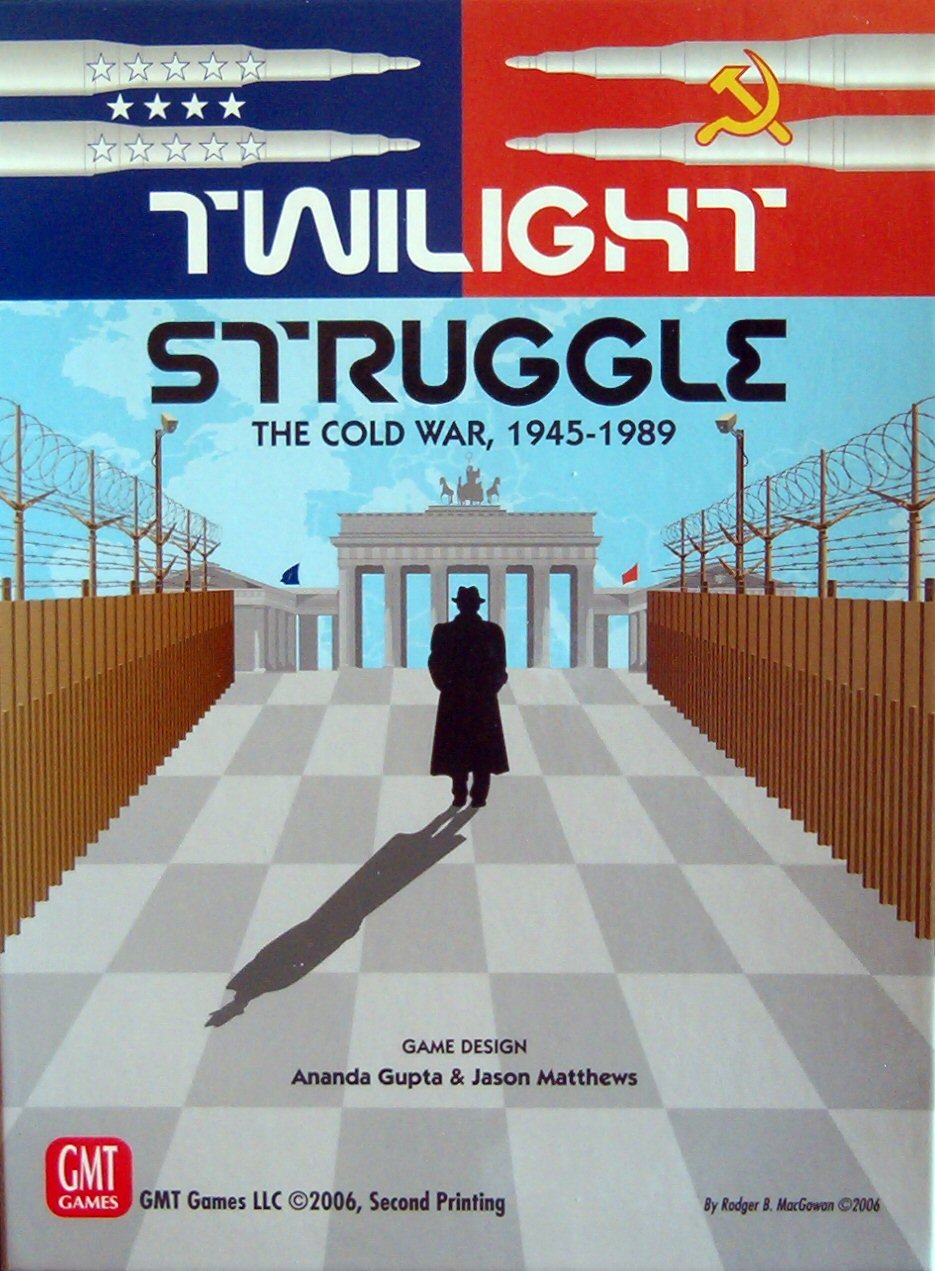
Twilight Struggle is my favorite two player game of all time. I would pretty much play it any time someone suggested it. When both players know the game well, it can take around 2 hours. I finally ran into the online Twilight Struggle ladder than runs through ACTS, a website that keeps track of the cards for you as well as some other information like what turn it is, what DEFCON is, and victory points. I'm using VASSAL to keep track of the board. After waiting for the previous round to end, I was finally been assigned an opponent last week. We rolled off, and I got the Soviets... but wasn't too thrilled by my opening hand.

   US/Japan Pact, 4 US
   DeGaulle, 3 US
   Duck and Cover, 3 US
   Defectors, 2 US
   Independent Reds, 2 US
   Captured Nazi Scientist, 1 Neutral
   UN Intervention, 1 Neutral
   Europe Scoring

Not a lot of Operation Points, and no Soviet events! This was not likely to become a Soviet steamroller game, so I know I am going to have to make sure I get solid gains in the mid game from the Western Hemisphere and Africa.


My opponent, Robert, put his initial influence out in a way that suggested Marshall Plan was coming - with 1 in Greece and 1 in Turkey. He did indeed headline Marshall Plan, and I lead off with DeGaulle Leads France, because he had put two influence in France. I often lead with a coup on the first action round, but with DeGaulle getting out there early, I used Duck and Cover to take France while giving up 1 VP. His first action was to take Spain and move through Malaysia while Cuba went into the hands of the communists.

My second action was to use the US-Japan pact to coup Iran, getting a strong US card out of the deck. Unfortunately I rolled low, which just emptied Iran of all influence. Robert went for a long shot by trying to coup Iraq, and missed.

I captured a Nazi scientist, while Robert put two ops into South Korea.

Two ops went into Afghanistan with defectors, and Robert played Asia scoring. This only gave him five early points with domination and one more battleground.

I went ahead and scored Europe, giving me 1 VP from controlling France for 1 more battleground.

Romania fell to the Soviets while the Americans influenced Lebanon to get some more Mid East presence.

In my final round, I used Independent Reds while cancelling it with UN Intervention, putting 1 in Syria and 1 in Iraq, and Robert finished with getting an earth satellite by pitching Decolonization.

This is how the board looks after turn 1:


I'm feeling comfortable but not thrilled by how my position played out, given my starting hand. Please feel free to critique my play or ask me questions about what my thought process was. Even after 100 plays, I am still learning the nuances of this deep game!

Chris

Saturday, June 4, 2011

For the People Session

I've played a lot of card driven wargames (CDGs) based on the system pioneered by Mark Herman's We the People. At this point, I would say I know these of them well: Twilight Struggle (my favorite 2-player game of all time), Hannibal, Paths of Glory, Washington's War (formerly We the People), Wildnerness War, and Napoleonic Wars. That's not say I'm good at them - I'm good at Twilight Struggle and Hannibal, and passable at the others. I'm pretty familiar with Here I Stand. I've at least played but don't feel entirely confident in the rules of Mark Herman's other two major CDGs, For the People and Empire of the Sun, and I own a few others that I need to play eventually, Shifting Sands, WW2 Barbarossa to Berlin, and Unhappy King Charles.

I recently posted on the GBG forums on BoardGameGeek that I had some wargame goals to try to fulfill over the rest of 2011. The main idea is to get much more familiar with these five games:

1. Fighting Formations
2. Europe Engulfed
3. Battles of the American Revolution System
4. For the People
5. Napoleon's Triumph

Later today at GBG I'll be playing Europe Engulfed in person for the first time. I've played one of the short scenarios from it online a few times, but I've always been eager to play the real game. We're going to play the 1941 scenario, which has Germany already conquered Poland and France. Apparently the 1939 scenario allows you to play out those early years, but has a lot more variance because a lot can go significantly right or wrong for the German player... so the 1941 start is recommended for new players.

Last night, my buddy Marc came over to relax and get some gaming in after some time he has been busy with work and his dad visiting. I suggested we play For the People or Napoleon's Triumph. We've messed around with For the People once or twice, and he has some interest in learning NT at some point. We decided on For the People since we at least had some experience and some of the rules down.


Every time I play For the People, I get more and more a sense that I am going to really love it once I actually know all the rules. This feels similar to learning Paths of Glory. I know another gamer who I can play this with, Richard - we played For the People at Origins a few years ago.

Marc and I rolled randomly for sides, and I got the Confederates. The short 4 card turn 1 went quietly, and on turn 2 I moved my army up from Richmond to next to DC. He left a gap in the line there, and I know there is a way to exploit that but wasn't quiet sure how. I decided to wait for Lee to show up and put him there, since Marc wasn't putting tons of troops nearby.

I took Kentucky with PC markers while the Union took West Virginia. I realized too late that in past games I've found it helpful to move troops up to the top of Kentucky and block off Union advances coming through Cincinatti, but as I realized it, he created an army there and started to move in. Marc put a lot of troops into this endeavor, and slowly whittled my army there down, while Lee started to bash into DC. One thing I really like about For the People and Paths of Glory is that both players have opportunities for going on the attack and taking ground. In Paths of Glory there are natural places where each side pushes, but in For the People it seems more a matter of where you get your generals (they are placed on the map randomly but in places you select) or where you reorganize your generals to. This lets you choose from a pretty wide open set of attack avenues.

Eventually Marc created a second army out west while his Army of the Tennessee held mine off defending Nashville, a valuable resource location. His second army came down west of the Mississippi, taking Arkansas, Texas, and Louisiana. Meanwhile, Lee eventually beat the army defending DC and forced the Union to relocate it's capital to Springfield, Illinois. The real difference maker in terms of Strategic Will (a score each side has that goes up and down as they have successes and failures) was Marc's use of Blockade cards to increase the level of Blockade. Each turn the Confederacy rolls for each of four zones and if they beat the Blockade level, they get a troop, and if not, they lose 2 Strategic Will points. Once the Blockade level got to 5, I was losing 6-8 SW points each turn. I was able to keep my points roughly even because of SW points you get when the Confederates have 3 spots in a state, due to Lee's adventures in Maryland, Delaware, and Pennsylvania.

In the end, Grant's arrival spelled the doom of my rebellious chances. Grant and Lee duked it out around Harrisburg, but due to my loss of reinforcements based on the loss of the my three western states, Grant was able to attrition the Army of Northern Virginia to dust, and the next turn take Richmond and complete the crushing of my will. I believe the game ended on turn 10 out of a possible 13, so we went pretty far.

I learned a lot about some of the rules I was hazy on, such as general reorganization. More importantly, I got to see a bit more about how the rules impact the game - they are making more sense in connection to the victory conditions. When you've only learned the rules and are playing a game the first few times, you might wonder things like "is it worth playing these Blockade cards?" but this play showed me the value of that aspect of the rules for sure.

I really want to play For the People again soon, to get the rest of the rules down. We were left wondering if there was more to using amphibious assaults and controlling the rivers. I'm planning to re-read the rules again today or tomorrow to get as much in as I can. I found the six hours I was playing the game felt like 2 or 3 hours, which to me is a sign of a great experience.


Chris

Sunday, April 3, 2011

GBG Report

The GBG is the Greater Boston Grogs, my monthly wargaming group. We sometimes end up playing a Eurogame or two after the wargames are over. My friend Andy hosts in his awesome basement in Wellesley, and I've been going for 4 years now and it's always great. We had 7 people for this meeting - three played Titan (not my favorite but my buddy Marc loves it) while Andy and Tom continued their ASL campaign game, a Stalingrad scenario called The First Bid. They are on turn 6 out of 19, and have played for multiple sessions already... impressive.

I played my favorite game of all time with Asher, Twilight Struggle.


If you haven't played this yet, go get it, play it at least five times, then get back to me. It's tense, it's deep, and it's elegant. This was my 96th recorded game since I started counting once I felt I knew the rules well enough, and I still keep coming back for more.

I was the United States for this game. This game went back and forth, but never got out of control. Asher's initial coup in Iran left Iran empty, and he didn't go in, and he won the Arab Israeli war, giving me no real opportunity to get back into the Middle East. Once I got rid of De Gaulle, I took France and got domination of Europe by taking Greece, Turkey, and Spain. The dice were not Asher's friends this game, and he bombed a number of coups and the Korean War. Eventually I was able to find my way back into the Middle East, by used Puppet Governments to put influence in Saudi Arabia and Libya.

Asher had a hard time getting over to the Western Hemisphere, since I used UN Intervention on Allende to keep him out of Chile, and I used Fidel on the space race. Eventually he was able to coup Venezuela, but around turn 9 I used realignments to remove his influence there. I got a big scoring out of Central America (8 points) to keep the game in control, while the rest of the world was basically a push. When the Pope showed up in Poland, I was able to grab it.

Finally on turn 9, I drew Cherobyl, which is always an exciting and difficult choice. My hand was mostly two Op cards, but since the only battleground he controlled was East Germany, I decided to go for it. Amazingly, he had the Iranian Hostage Crisis, then Terrorism - forcing me to discard two cards, which would lose me a card play and 2 Ops. I started putting influence into East Germany slowly but surely. He followed this up with Persing II Deployed, which removed 3 of my influence in Europe!

On turn 10, I drew a strong hand with three 4 Op cards and Europe Scoring. It takes me a few turns to finally get control of all of the battlegrounds and I win by scoring Europe. Asher is at 9 VPs and shows me that he had Wargames in hand, and just needed two more actions to get DEFCON down to 2 and he would have won. Wow.

Twilight Struggle took us exactly two hours - once both players know the game decently well, it's rarely longer than 2.5 hours. After Asher left, Eric and I played a quick game of one of the old Napoleon at War SPI quad folder games. It was a pretty light move and shoot, hex and counter game, with the main distinction being that every adjacent enemy HAD to be attacked, which led to some interesting situations in how to move your forces in. We just played the shortest scenario which was five turns, and neither of us was able to cause auto-victory by killing forces, so the French (me) lose if they have not reestablished their line of communication with the western map edge.

Overall, another fun day gaming with friends. I'm looking forward to roping someone into playing Fighting Formations with me next month, since it didn't arrive in time for this meeting.


Chris