Search This Blog

Saturday, July 23, 2011

LibertyCon Part 2

Day 2 of LibertyCon was on Friday July 1, and I got to play tons of games, including two for the first time. Here was the lineup:

   Labyrinth
   Indonesia
   Dream Factory
   Taj Mahal
   Princes of Florence


This was my second game of Labyrinth, again playing against Andy L. I took the Jihadists since the last time we had played (at the TotalCon game day), I had the Americans. This game has quite a bit of asymmetry! Again Andy took me out in pretty quick order, getting a successful conversion of the Gulf States to Good governance and then rolling from there. I like the learning curve here, there's things to learn about - how do you respond to things that your opponent does makes a big difference in whether you can hold them off or get rolled.


I had been waiting a long, long time to play Indonesia. Every time I've been at Eric's, I've looked longingly at the game sitting on the shelf and even read the rules once while between games. It's highly rated on BoardGameGeek, and sounds exactly like the kind of game I really like: heavy and economic. The way you can merge companies in the game sounded really interesting, and the people at LibertyCon who played it before seemed enthusiastic about it. So finally I was going to get my chance!

After the first play, I was left feeling like I really liked Indonesia. It had some similarities to 18xx games in that you were controlling companies that had to operate, but without the track laying. People have complained about the graphic design and components, which while beautiful, really do get in the way of game play. Some of the areas on the board are way too small, especially since the component used for a city is a glass bead.

One of the most fascinating and bizarre aspects to the game is that you can cause two companies to merge. The strange thing about the way it works mechanically is that one player can cause two companies owned by two other players to merge, and there is nothing they can do to stop it. This makes Indonesia really feel pretty abstract and unreal, but from a game standpoint it's a really interesting mechanic. I was looking forward to playing it again soon so I could try out some different things.


After that, Eric taught us Traumfabrik, which has recently been printed in English as Dream Factory. This game was a lot of fun - you get three movie scripts which require different components: for example an actor, a director, and special effects. Another script might require two actors, a camera, and a director. Some actors are better than others, so all of the pieces have a value. When you finish a film, you get points for it based on how good the actors, directors, etc. that you got were. You are bidding currency in a closed economy: after the winner gets the pieces they just bid on (they come in lots of 2 or 3 components), you divide the money up amongst the other players. This means that the game ebbs and flows for each player because if you are not winning auctions, you are accumulating money for future auctions. You also get to see which lots are coming up ahead, so a key is timing your expenditures so you get the best stuff for your films. The scoring is cute and nicely done: after a certain number of lots, the person with the best finished movie gets some points; at the end of the game you get points based on things like best comedy. I'm not entirely sure but I may have won this game, or at least come close. Considering I hadn't really heard all that much about this game, I have to say I found it really just plain fun. Easy to learn with plenty going on to think about. I'm not sure why this game isn't as popular as some of Knizia's other light, auction games like Ra, Amun-Re, Modern Art, or Medici.

Speaking of other Knizia games, we then got a group together for Taj Mahal, which is one of the games I own that I have not played nearly enough. (Another Knizia, Amun-Re, is also in that category.) I decided I was going to explore the design space in this game instead of focusing on a greedy strategy, which is my default, and instead pick out a more defined strategy to push for and stick with it. For those of you who don't know Taj Mahal, there are 12 rounds of bidding for things in different districts on a map. You play one or two cards which have various symbols on them, or you withdraw from the bidding. When you withdraw, if you are leading in one of the symbols, you get that reward for that district. Four of the symbols let you put a castle down in that district and get a piece that is 1/2 of a special power card, one of them lets you put an extra castle down that doesn't take up a space so can share with someone else, and one (elephants) lets you get a tile from that district that has some picture of a good on it. There are other little tokens on spots that when you put a castle down, you get the token and some of those also have goods on them. You get points when you acquire a good based on how many other of that good you already have. When you withdraw, you also get to pick two cards from an array that is put out before the card plays.

The interesting thing in Taj is that you might not be winning anything and have to decide whether to push for it, or to cut your losses now and try to get an early pick of new cards. This can be a pretty fascinating decision, at times. The strategy I decided to try was to take elephant cards as often as possible, and try to win as many of the goods tiles as I could, and see if that was a viable way to try to win. Eric's son-in-law ran to victory by making chains of castles, which is another way to get bonus points, but I did end up in second, even though my strategy became quickly obvious to everyone at the table and they started actively trying to get in the way of it. Good stuff!


The last game I played on game 2 was one of my all time favorites, The Princes of Florence. I'm biased because it's the game I've done the best at in the WBCs, coming in 4th and 2nd in back to back years. I feel like I've lost my touch a little bit because it's hard to find people to play this game, especially to get a five player game. This game at LibertyCon was with a bunch of WBC eurogame veterans and really felt like the quality of a semifinal game. I've found at WBC the first round heats are very winnable in games that you like a lot and practice at, but the difficulty really rachets up in any semifinal game. I've made the semifinals of lots of games: Puerto Rico, Power Grid, Caylus, Ra for example, but only won a semi in Princes of Florence.

Anyway, this was a really tight game. I had artists with four different buildings since I was in seat 4, so I decided to try to push builders a little more than I normally would. For a game that seems so tight and simple, the variance in the cards you get and the chaos created by the player dynamic adds quite a bit of replayability. I was able to get a late "least open spaces" Prestige card which saved my game a little bit, but I believe I ended up coming in third. I wish I could get a few more games of this in before WBC, but maybe I'll find an open gaming game of it during the pre-cons.

Chris

Tuesday, July 5, 2011

LibertyCon Part 1

My wife and I were invited to partake in a nearby home-based mini-convention this past weekend and had a wonderful time. The hosts Eric and Claire were fantastic, and I made sure to get in some games with each of them based more on their preferences than mine. Part of that is me wanting to see what they like about the games they like, that I can't get other groups I know to play, such as the 18xx games and the Empire Builder series of games.

Here was the games I got in on the first day:
   Bohnanza
   Daytona 500
   Thurn and Taxis
   Slate
   Blue Moon City
   Rallyman
We started off with Bohnanza, which I suggested. I have only played this once, many years ago, and remembered really liking it. Since my wife and I love Agricola and Le Havre, I wanted to revisit it. I once again enjoyed it, and appreciated the way the game makes everyone eager to trade without making trading a painful process. Maybe another group would play slower and trade more carefully, but our game had a nice smooth feel to it. I'm not really into buying light games like this anymore, but I would probably play this game when I felt like something lighter and someone had it with them. I ended up winning somehow, which was a nice way to start the convention!

For those of you who have not played Bohnanza, it's pretty simple to explain. You get a hand of cards that need to stay in order in your hand. You have two "fields" on the table where you can plant a bean, and you have to plant the same kind on that stack - so you can have three Blue Beans and three Coffee Beans on the table. When you have a certain number, you can decide to harvest the beans, and based on how many, get 1 to 4 points - you take that many of the Bean cards and flip them over and put the rest in the discard. The cool part is that means there are less of that kind in the deck, which gets reshuffled a number of times. So if you pay a little attention, you might be able to figure out which beans you are likely to be able to collect. There's a little more to how the beans get planted and traded, but that's the basic idea.

Eric suggested another light game next, a really old Milton Bradley game called Daytona 500. I was a little skeptical, but this game was fast and pretty fun. A basic racetrack with spots for the cars, with three lanes but only one around the curves which forces the cars to sort of squeeze in and made it feel a little more realistic. You get a hand of cards with a bunch of number-color circles on them, like Blue 6 - Red 4 - Black 2. That means that when you play that card, you move the blue car 6, the red 4, and the black 2. If a car is behind another when it moves, that car gets to move 1 space. You look at your hand and then pick which car you want. You play one lap around like that and then the first player moves and you do it again. It was kind of interesting how other people were moving your car for you, and sometimes even pushing you over the finish line!

Usually light games are a one and done affair for me, meaning I would play them again but just not in the same weekend. I actually found myself nearly suggesting this one to get my wife to try it!

 
We got in a game of Thurn & Taxis, a game that continues to be a good choice when I want something light that I know involves a lot of skill so there are things I'm still working at figuring out about how to play well. Since Andy L. hadn't arrived yet, I had a chance - he's a shark at this game. I did decently but not great in this one, as the cards just didn't quite agree with me. I had a weird game where at one point I had a three card route and five cards in my hand which didn't touch the route or each other!


Joe H. showed up, who is known among this crowd as the 18xx guy because his skills with Excel and quick math really speed any 18xx game up, and he suggested this game called Slate. It's a small, relatively quick game by Martin Wallace that was publishing in a German magazine called Spielbox. A nice, interesting Eurogame - you roll three dice on your turn, and they decide your actions - you can get a new worker (as in El Grande) on a 1 or 2, dig a mine on 2 or 3, harvest a mine on 4 or 5, and buy a special benefit on a 6. You cSome of the special benefits get you end game victory points, one of them lets you change one of your dice up or down 1 pip (and you can go from 1 to 6 or 6 to 1 as well), etc. You can reroll some of your dice ala Yahtzee, Roll Through the Ages, or Ra: The Dice Game. Pretty fun game - very interesting for the small amount of rules and playtime.

Andy L. did happen to show up at this point (and I was actually sad he missed Thurn, because I want to see more of how he plays it), and him and Eric's daughter Jo brought out Blue Moon City. I had seen this game at my friends house (D&D Andy) and took a quick read through the rules at some point there and it seemed interesting. Move your piece one square tile left or right on a grid, then hand in cards of various colors to complete the structures on those tiles, getting you rewards such as victory points, more cards, etc. For my money it was a little too abstract. While I enjoyed it, I wouldn't rush out to play it again or buy it.... probably rate it around a 5 or 6. When I first discovered designer boardgames, I would have loved this game. I'm more into heavier games nowadays and I guess I prefer a tiny bit more theme in my games.
I was trying to decide whether to play another game, when Joe H. said that he really wanted to play Rallyman. What I had read about it didn't sound that great, and I would have to say this is probably my least-liked new game in a long, long time. I generally at least like pretty much anything, but this just didn't cut it. It had an interesting take on pressing-your-luck with dice and planning out your upcoming movement, but it didn't provide any twists or changes in game play during the game. The staggered start was vaguely compelling, but the sum of it all was what I would call... tedious. It also really was pretty much the definition of multiplayer solitaire. Well, when you are trying new games, you win some and you lose some, so I'm not upset that I gave it a shot.

This first day of the convention was a nice, relaxing, and fun start - I went home excited and looking forward to playing heavier, deeper games over the next few days!

To be continued....

Chris

Saturday, June 25, 2011

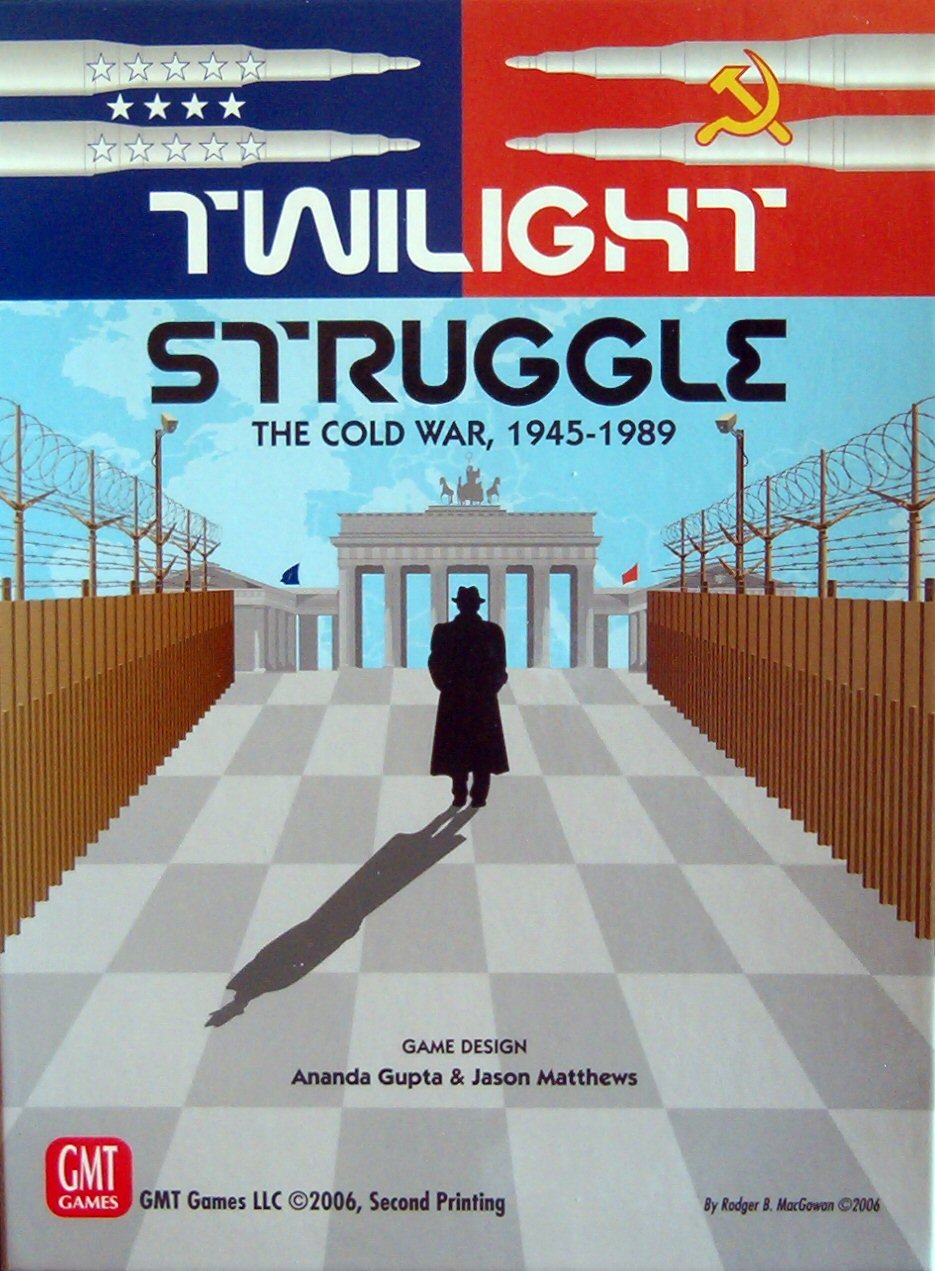
Twilight Struggle Ladder Turn 2

My opponent in my Twilight Struggle ladder game was out of town on business, so it took a little longer than usual to finish turn 2. As you may recall, I had a decent start after taking France, being given Cuba by Fidel, capturing a Nazi scientist, and leaving the Iran-Pakistan area empty. This was the board after turn 1:


My hand for turn 2:
   Nuclear Test Ban - 4 Neutral
   NATO - 4 Neutral
   De-Stalinization - 3 USSR
   Warsaw Pact Formed - 3 USSR
   East European Unrest - 3 US 
   Vietnam Revolts - 2 USSR
   Olympic Games - 2 Neutral
   Truman Doctrine - 1 US
   China Card - 4 Neutral

A perfectly fine hand, and I'm always happy to get De-Stalinization in my hands as the Soviets so the Americans don't use it to fund their space program.

Robert headlined Containment, upping all of his Op cards, while I had the Vietnam Revolt go off first, putting 2 influence in Vietnam.

I lead off with a very successful coup in Panama, getting it to 5 USSR influence, and Robert predictibly took Thailand in response to my nearby Vietnamese presence, while also spreading to Egypt.

NATO was formed while I took Iraq and Saudi Arabia, and Robert took Egypt and Jordan.

I made my move with De-Stalinization, taking influence from Romania, Bulgaria, Vietnam, and Panama, in order to take Brazil and Argentina. Robert's CIA (with Containment) took Laos and spread 1 into Algeria. I wish I had had time before then to take Algeria since I have influence in France, but TS forces you to prioritize!

Random Twilight Struggle musings: for those of you new to the game or still learning it's intricacies, here is why I took Brazil and Argentina. It's very possible for the USA to completely shut the Soviets out of the Western Hemisphere, so I take establishing myself there as a priority, unless I think I can win with a quick auto-victory. The Panama Canal Returns card in the Mid-War deck puts a USA influence in Venezuela, so I prefer to move in there later - I'm not sure about this. The Allende card puts Soviet influence in Chile, so there's no reason to put any there first. The one other thing I should have considered more strongly was putting two into Mexico. That would have given me a strong chance to control Central America by just grabbing Costa Rica at some point. I decided to go for a more balanced approach that might let me Dominate both Central and South America.

I decided to fight for it, and put 2 there and 1 into Pakistan. He played Socialist Governments, and simply replaced what he lost, and put the extra 1 from Containment into Burma.

Feeling the creeping American presence on the Asian continent, I went ahead and spent the China Card to take Pakistan and India in one fell swoop. He played the Korean War to take Taiwan, but I got lucky and rolled a 6 to take South Korea!

My final card play was to send East European Unrest into space, which was successful, putting me into having an Animal in Space. Robert successfully space raced as well, using the +1 from Containment to spend Nasser.

Here is the board state as it was after turn 2:


After losing 2 points for missing Military Operations, the VP marker was at 1 for the USA. However, I am very happy with the board position. I have lots in the Western Hemisphere, Domination in Asia, and a turn 3 coup of Egypt could put me in a good state in the Middle East. 


Chris

Saturday, June 18, 2011

Napoleon's Triumph


Napoleon's Triumph is rated 9th in the wargames category on BoardGameGeek, and 71st overall. Clearly one of the best wargames I hadn't really played much. Others that are highly ranked but played once or not at all include War of the Ring, Friedrich, Maria, and the Great Battles of History series. I'm currently in the midst of a Europe Engulfed game with Andy from GBG, so that's putting that one to rest finally.

I finally got to play Napoleon's Triumph today at the meeting of SNEW - the Southern New England Wargamers. My opponent, Scott, was willing to be patience with my newness to the game. 85% of the rules to this game are understandable, sensible, and easy to remember. Your forces are blocks that can be infantry, cavalry, or artillery, from 1 to 3 strength. They can be in the center of an area, or blocking one of the edges of the area. They can be grouped with a commander to form a corp. There are four different kinds of commands you can give them: a whole corp moving together, one or more units detaching from a corps and moving, attaching a unit to a corp, and a unit not in a corp can move. You are limited in the number and kinds of commands you can give, and it's all quite elegant.

The victory conditions are pretty interesting and force the narrative in an excellent way. The Austrian/Russian coalition is on the attack and pushing for victory areas. If they are getting there, the French player can add two more corps to the board, and the victory conditions now change to the French having to get victory areas on the other side of the board. It gives both players a chance to be the attacker, and adds tough decisions for both players.

Where the game loses me a little bit is the combat system. For starters, it's very particular and I can easily see misplaying the rules. Since I don't get to play any specific game often enough, it's really hard to imagine ever really learning the combat rules well - they are hard to keep in your head because of all of the details. Maybe it's just the way the rules are written. It describe the combat procedure step by step, and all of the exceptions are listed as they occur in the sequence. I would almost prefer to see the general procedure, and then all the exceptions for artillery listed afterwards, etc. The bigger difficulty for me is the learning curve to understanding the play ramifications of the combat system. This is a huge factor in playing the game well - knowing how the various types of units should be used, where on the map they would be most effective (both in terms of the terrain penalties and in terms of the width of the borders which can fit one or two attackers), and how the combat system plays out in general really seems quite obtuse and tricky. I wonder how long it would take me to really be able to play this game well - there's something about it I think is hard for the way I think.

I was the French player in this game, and Scott moved towards me slowly, using feints to slowly spread me out but not really pushing to hurt me too badly. He left one side of the board completely unengaged, and just whittled me away until about two thirds through the game, when he started to really pound harder. By doing this, he gave me too few time to counterattack, so I'd have to win by morale, but he pushed my morale down to 0 easily. A pretty fun game, but I was hoping for more somehow. I just felt like the combat system is too much work for too little benefit, but maybe that would change with repeated plays. I generally like combat resolution to be fast and furious, which I guess this system might be once your know it well. If I played the French again, I might try loading up a few strong units and attacking while being attacked elsewhere.

Chris

Saturday, June 11, 2011

TotalCon Game Day

We just got back from TotalCon game day at a store in Plainville, MA called Battlegrounds. A very nicely set up gaming store, and the regular TotalCon crew plus a bunch of people playing games. The event started at 10, but we showed up a little after noon.


I was very happy to see a group of four people sitting down to play Automobile. When I arrived, they had just about finished going over the rules, so it was perfect timing! I put myself in last in the turn order since I was a latecomer, and away we went. (Bronwen took the car to visit a nearby quilting shop for a bit, but showed up for gaming a little while later.) The first turn I took Sloan as a fifth pick - I've been burned by those loss cubes too often that I might be a little too careful and paranoid about them. I grabbed the first economy car space and used three salesmen to get rid of them, but since I made two factories, I ended up with two cars and two loss cubes, which Sloan put back to one. The second turn, I was earlier in the turn order, and took Howard. I built one of the luxury car spaces and again ended up with a decent, but not amazing turn - but very few loss cubes. On turn three, I was back to Sloan, and built a mid-sized car factory in the $650 range. Turn 4 I got Chrysler and put a second factory in that spot along with the parts factory and pumped out a lot of cars.

I'm fascinated by the ability to win this game with different styles. It seems like you can do well by being aggressive, building a lot of factories and making a lot of money, but also taking loss cubes, and sometimes a lot of loss cubes through gambling play. But you can also do well by playing the way I did this game - make sound, solid investments without overdoing it, keep your loss cubes low, and don't ever have to take a loan. Three of the other players took loans in this game. I ended up in second, but the first place finisher beat us by a sound margin, something like $4400-$3570-$3300-$3100-$2800. The winner also took no loans, so in this game the loans seemed really bad, although the third place finisher was more than the $300-$400 back he would have saved by not taking those loans. I find myself only wanting to take Sloan, Chrysler, and Howard, and shying away from the other three. There's a more to this game to explore than it might even seem at first. I have to say I was feeling the game was pretty mechanical and dry, which is pretty strange because I often love games like that - but this play went by much smoother than previous plays and hence was much more enjoyable.

My friend Andy - not the guy who runs GBG, but another Andy who has played at GBG, has been trying to get me to play Labyrinth with him for a while now. We've played Hannibal, Washington's War, and Here I Stand together in the past, so we share an interest in CDG wargames. I've been hesitant to get into this one though. I wasn't sure I was that excited by the topic it is portraying, and I want to get good at the CDGs I already have, not to mention play those I have and haven't played yet. (WW2 Barbarossa to Berlin, Shifting Sands, Unhappy King Charles) Somehow something snapped in me the last time I ran into Andy, and I started looking into Labyrinth more. I finally picked up a copy two days ago, read the rules, and ran through two turns of a solitaire game yesterday. The solitaire mode is a little tricky, since it's very procedural. You have to play the opponent as if they were a player, and a somewhat involved flowchart helps you figure out what they are going to do with their card on their turn. So it was good to see Andy at the game day and finally give him his chance to teach me the game. I would be playing the United States fighting the Jihadists.

Even after what I thought was a pretty careful reading of the rules and a careful two turns yesterday, there is still a lot going on in this game rules-wise that you need to keep in your mind or at the least constantly refer to the reference sheets for. You have a number of options on your turn - but each of them can only be played in countries based on certain conditions, so it led to a lot of rules corrections by Andy like "no you can't do that, that option can only be done to an Ally country". I wouldn't call the game elegant, but it definitely is interesting, and might just take time to grasp what is going on. It certainly wasn't clear what I should be doing to really have any shot of stopping the seemingly endless waves of sleeper cells spreading out from Afghanistan through Pakistan, eventually establishing Islamist regimes in Saudi Arabia (which I invaded to Regime Change), Pakistan, and finally Iraq, winning Andy the game in pretty short order. Granted, we played the shortest version of the game, where you go through one desk.

Based on this game, it feels like either this will be the way to play it and it will get much faster once I know the rules better. In that case, maybe the feel of the game is a close see-saw that at some point topples and you slide down to your doom. The other possibility is that the "two deck" version is the way the game should be played, and hopefully that will provide a little more opportunity for back and forth as perhaps some of the luck of the cards will even out. It certainly felt like a lot of powerful jihadist events were occuring... Definitely a fun and intriguing game, thanks to Andy for being so enthusiastic about it!

Most of the other people in the room were involved in a game - Bronwen was back and in a four player game of Brass that was only half over. So Andy and I decided to find a shortish game that might fill the time, and he suggested another one of the games he is obsessed with, Innovation. I had only played it once before, with him and another person last year sometime. I wasn't all that impressed, as it seemed fairly goofy and chaotic, but I wasn't ready to give that as a firm grade or anything yet. I was willing to give the game another go with just two players. I suspected that I would like it a little better that way, because you would be able to plan more, although the nature of the cards is still pretty tactical. I had fun with it today, as we both got close to winning but when Andy had a good chance of winning on the next turn, I played the fission card shown below, and won the game in the following re-start.... pretty crazy stuff.
Innovation is the game Fluxx wishes it were. That's kind of where I am with it, and I'd be glad to play it again, but I'm not going to own it or study it...

After that, I got in a four player game of Navegador. Why is it that the rondel games keep calling me back lately? This one featured Bronwen, another good friend Joel, and a guy we just met, whose name I believe is Star. This game creeps closer and closer to the line of me buying it! I thought I was in pretty good shape when I had four sugar colonies behind Joel's multiple sugar factories, but I think I let that opportunity slip away, grabbing a few early prestige tokens when I should have been building up my infrastructure more. I should have jumped on building cathedrals and then workers. In the end I was a little too diversified and came in last, and it was a great learning experience. This is a really cool game, and I think I just convinced myself to buy it while writing this.

To cap off the night, we had a four player Stone Age. I'm really glad this game came back to me at Unity Games - literally the copy I hadn't had in two years was returned to me! Star happened to have an expansion for the game which was pretty neat, six new huts that offered bonuses like +1 farm or +1 villager, but also some that generated a resource every turn. At the start of the game you remove 6 of the original huts, then shuffle these in. It makes the game a little less predictable for those who know the huts really well. I was the starting player and I grabbed a farm to start, and on the way back took a gamble to get a card for 2 resources that had the "magic dice" on it. Of course all the wood spots were gone, so I got to put 3 workers in for bricks. Luckily I just barely got two bricks and rolled a 6 on the magic dice to put me at two farms. I was able to get my farms up to 7 by the end of the game, and had 2 more babies to get 7 villagers, got 3x multipliers for each of them, had 3 tools, and was pretty efficient with the huts I built. This was probably the best I have ever done with a board that looked pretty diversified at the end as I won with 150 points even. The only other times I've done well in Stone Age are when I've done starvation and gotten tons of huts and meeple modifier cards, or I got tons of farm multiplies. This was a really fun game, although I do dislike the death spiral it seems that one player always ends up in. This time it was Bronwen in seat 3, but she handled herself as sportsmanlike as always.

Overall, another great day of gaming - it was nice to grab a win in Stone Age since I haven't been that good at it in the past... especially after getting destroying in Labyrinth (understandable) and Navegador. I was happy with my second place in Automobile, but I'm still not entirely sure what makes people win or lose in that game yet, but I feel something in my subconscious is working at it. Innovation... well, that's just crazy. Maybe I should not play it again and say I have a perfect record in two-player competition!

Chris

Wednesday, June 8, 2011

Twilight Struggle Ladder Turn 1


Twilight Struggle is my favorite two player game of all time. I would pretty much play it any time someone suggested it. When both players know the game well, it can take around 2 hours. I finally ran into the online Twilight Struggle ladder than runs through ACTS, a website that keeps track of the cards for you as well as some other information like what turn it is, what DEFCON is, and victory points. I'm using VASSAL to keep track of the board. After waiting for the previous round to end, I was finally been assigned an opponent last week. We rolled off, and I got the Soviets... but wasn't too thrilled by my opening hand.

   US/Japan Pact, 4 US
   DeGaulle, 3 US
   Duck and Cover, 3 US
   Defectors, 2 US
   Independent Reds, 2 US
   Captured Nazi Scientist, 1 Neutral
   UN Intervention, 1 Neutral
   Europe Scoring

Not a lot of Operation Points, and no Soviet events! This was not likely to become a Soviet steamroller game, so I know I am going to have to make sure I get solid gains in the mid game from the Western Hemisphere and Africa.


My opponent, Robert, put his initial influence out in a way that suggested Marshall Plan was coming - with 1 in Greece and 1 in Turkey. He did indeed headline Marshall Plan, and I lead off with DeGaulle Leads France, because he had put two influence in France. I often lead with a coup on the first action round, but with DeGaulle getting out there early, I used Duck and Cover to take France while giving up 1 VP. His first action was to take Spain and move through Malaysia while Cuba went into the hands of the communists.

My second action was to use the US-Japan pact to coup Iran, getting a strong US card out of the deck. Unfortunately I rolled low, which just emptied Iran of all influence. Robert went for a long shot by trying to coup Iraq, and missed.

I captured a Nazi scientist, while Robert put two ops into South Korea.

Two ops went into Afghanistan with defectors, and Robert played Asia scoring. This only gave him five early points with domination and one more battleground.

I went ahead and scored Europe, giving me 1 VP from controlling France for 1 more battleground.

Romania fell to the Soviets while the Americans influenced Lebanon to get some more Mid East presence.

In my final round, I used Independent Reds while cancelling it with UN Intervention, putting 1 in Syria and 1 in Iraq, and Robert finished with getting an earth satellite by pitching Decolonization.

This is how the board looks after turn 1:


I'm feeling comfortable but not thrilled by how my position played out, given my starting hand. Please feel free to critique my play or ask me questions about what my thought process was. Even after 100 plays, I am still learning the nuances of this deep game!

Chris

Saturday, June 4, 2011

For the People Session

I've played a lot of card driven wargames (CDGs) based on the system pioneered by Mark Herman's We the People. At this point, I would say I know these of them well: Twilight Struggle (my favorite 2-player game of all time), Hannibal, Paths of Glory, Washington's War (formerly We the People), Wildnerness War, and Napoleonic Wars. That's not say I'm good at them - I'm good at Twilight Struggle and Hannibal, and passable at the others. I'm pretty familiar with Here I Stand. I've at least played but don't feel entirely confident in the rules of Mark Herman's other two major CDGs, For the People and Empire of the Sun, and I own a few others that I need to play eventually, Shifting Sands, WW2 Barbarossa to Berlin, and Unhappy King Charles.

I recently posted on the GBG forums on BoardGameGeek that I had some wargame goals to try to fulfill over the rest of 2011. The main idea is to get much more familiar with these five games:

1. Fighting Formations
2. Europe Engulfed
3. Battles of the American Revolution System
4. For the People
5. Napoleon's Triumph

Later today at GBG I'll be playing Europe Engulfed in person for the first time. I've played one of the short scenarios from it online a few times, but I've always been eager to play the real game. We're going to play the 1941 scenario, which has Germany already conquered Poland and France. Apparently the 1939 scenario allows you to play out those early years, but has a lot more variance because a lot can go significantly right or wrong for the German player... so the 1941 start is recommended for new players.

Last night, my buddy Marc came over to relax and get some gaming in after some time he has been busy with work and his dad visiting. I suggested we play For the People or Napoleon's Triumph. We've messed around with For the People once or twice, and he has some interest in learning NT at some point. We decided on For the People since we at least had some experience and some of the rules down.


Every time I play For the People, I get more and more a sense that I am going to really love it once I actually know all the rules. This feels similar to learning Paths of Glory. I know another gamer who I can play this with, Richard - we played For the People at Origins a few years ago.

Marc and I rolled randomly for sides, and I got the Confederates. The short 4 card turn 1 went quietly, and on turn 2 I moved my army up from Richmond to next to DC. He left a gap in the line there, and I know there is a way to exploit that but wasn't quiet sure how. I decided to wait for Lee to show up and put him there, since Marc wasn't putting tons of troops nearby.

I took Kentucky with PC markers while the Union took West Virginia. I realized too late that in past games I've found it helpful to move troops up to the top of Kentucky and block off Union advances coming through Cincinatti, but as I realized it, he created an army there and started to move in. Marc put a lot of troops into this endeavor, and slowly whittled my army there down, while Lee started to bash into DC. One thing I really like about For the People and Paths of Glory is that both players have opportunities for going on the attack and taking ground. In Paths of Glory there are natural places where each side pushes, but in For the People it seems more a matter of where you get your generals (they are placed on the map randomly but in places you select) or where you reorganize your generals to. This lets you choose from a pretty wide open set of attack avenues.

Eventually Marc created a second army out west while his Army of the Tennessee held mine off defending Nashville, a valuable resource location. His second army came down west of the Mississippi, taking Arkansas, Texas, and Louisiana. Meanwhile, Lee eventually beat the army defending DC and forced the Union to relocate it's capital to Springfield, Illinois. The real difference maker in terms of Strategic Will (a score each side has that goes up and down as they have successes and failures) was Marc's use of Blockade cards to increase the level of Blockade. Each turn the Confederacy rolls for each of four zones and if they beat the Blockade level, they get a troop, and if not, they lose 2 Strategic Will points. Once the Blockade level got to 5, I was losing 6-8 SW points each turn. I was able to keep my points roughly even because of SW points you get when the Confederates have 3 spots in a state, due to Lee's adventures in Maryland, Delaware, and Pennsylvania.

In the end, Grant's arrival spelled the doom of my rebellious chances. Grant and Lee duked it out around Harrisburg, but due to my loss of reinforcements based on the loss of the my three western states, Grant was able to attrition the Army of Northern Virginia to dust, and the next turn take Richmond and complete the crushing of my will. I believe the game ended on turn 10 out of a possible 13, so we went pretty far.

I learned a lot about some of the rules I was hazy on, such as general reorganization. More importantly, I got to see a bit more about how the rules impact the game - they are making more sense in connection to the victory conditions. When you've only learned the rules and are playing a game the first few times, you might wonder things like "is it worth playing these Blockade cards?" but this play showed me the value of that aspect of the rules for sure.

I really want to play For the People again soon, to get the rest of the rules down. We were left wondering if there was more to using amphibious assaults and controlling the rivers. I'm planning to re-read the rules again today or tomorrow to get as much in as I can. I found the six hours I was playing the game felt like 2 or 3 hours, which to me is a sign of a great experience.


Chris